“Using Learner Reviews to Inform Instructional Video Design in MOOCs”

ANNOTATION: Deng, R., & Gao, Y. (2023). Using Learner Reviews to Inform Instructional Video Design in MOOCs. Behavioral Sciences13(4), 330. https://doi.org/10.3390/bs13040330

Video watching is the most common instructional resource in MOOCs, and many studies have been completed to determine students’ impressions and preferences. However, according to the authors, most of these have been small studies, so these authors set out to analyze learner behavior at Chinese University MOOC, which offers more than 10,000 courses from 700+ Chinese institutions of higher education. The goal of the research was to characterize which video features higher-ed learners favored most, types of resources learners valued as supplements or in-video features, and which video production features learners liked best.  Conclusions were that learners favored videos that were, in order: organized, detailed, comprehensible, interesting, and practical. They deemed slides, readings, post-video assessments, questions embedded within the video, and case studies as helpful. And finally, LENGTH of video was learners’ most important factor for video satisfaction, more important than editing quality, video resolution, presence of subtitles, music, or voice.

The researchers collected data from 1,648,747 MOOC reviews in fourteen categories that included courses in sciences, humanities, law, the arts, sports, and psychology. Learners provided ratings and text-based reviews, all of which were publicly available. Numerous entries were excluded from the data, for a variety of reasons, such as being too brief, unclear, or generic to be considered. The final number was cut down to 4,534, and these were analyzed using MAXQDA Analytics software. The authors used a grounded method to analyze the data, allowing themes to emerge during the data analysis rather than imposing a theoretical framework on the body of data. Two teams of knowledgeable researchers coded the data separately and cross-referenced results to adjust for discrepancies in coding.

Some key takeaways suitable for the development of educational video in any online asynchronous model:

  • Organization of information is highly valued, above all. Learners appreciated carefully designed videos with adequate amounts of detail and clear organizational structure that is easy to follow and to understand.  Learners want to understand the logical connections between key concepts. According to the authors, “Our analysis suggest that learners likely prefer shorter videos due to the prominence of key points and their attentional state being optimized.”
  • “Interesting” videos are those are fun to learn from, and students appreciate humor, storytelling, and other engagement tactics.
  • Practicality matters: learners seek information that is relevant to their present life and work.
  • Length of video is critical. Learners prefer short videos because that allows the key points to stand out. The researchers suggested that often, shorter videos mean that sufficient pre-production time was devoted to clarifying the content and no information was extraneous. They felt that they could stay focused more readily in shorter videos and could fit short-video viewing into pockets of time they had available for their online studies. 

Having read an article on video-watching behavior in EdX MOOCs from 2015, I sought the most current study I could find to determine whether viewing behavior in MOOCs had changed much since the advent of short-form video. I discovered this study and discovered that the findings were very much in line with EdX’s 2015 conclusions. However, this study was done with MOOCs in China, so it is unclear as to how much those viewers may have been affected by current American video-watching trends with young audiences, including TikTok and Instagram reels. More research is needed.

“How Video Production Affects Student Engagement: An Empirical Study of MOOC Videos”

ANNOTATION: Philip J. Guo, Juho Kim, and Rob Rubin. 2014. How video production affects student engagement: an empirical study of MOOC videos. In Proceedings of the first ACM conference on Learning @ scale conference (L@S ’14). Association for Computing Machinery, New York, NY, USA, 41–50. https://doi.org/10.1145/2556325.2566239

This study evaluated engagement via student behaviors while watching video within edX® MOOCs. The authors used data from 6.9 million video-watching sessions across four edX® courses: Intro to Computer Science and Programming (MIT), Statistics for Public Health (Harvard), Artificial Intelligence (Berkeley), and Solid State Chemistry (MIT). As of 2014 when this study was published, it represented the largest-scale study of video engagement to date. The goal was to determine engagement, defined by two conditions: engagement time and problem attempt (whether the student completed an assessment question after the video). The authors noted that they did not measure true “difficult-to-measure” engagement, as that would require direct observation and questioning to determine true engagement, such as whether a student was actively watching an entire video or rather was playing it in the background while multitasking.

Data was gathered using a mixed methods approach, combining quantitative data from video watching sessions from the four courses and qualitative data via interviews with six edX® staff who were part of the production team for those courses. The quantitative data included: start and end times, video play speed, numbers of times the student pressed play/pause, and whether the student completed an assessment question after watching the video. The researchers also looked at video properties such as length, speaking rate of the instructor, video type (lecture or tutorial), production style (slides, code, Khan-style whiteboard, live classroom, studio, office desk), and finally interviews with staff for feedback and input. The six staff members interviewed included four video experts at edX®, as well as two program managers who coordinated among edX® and university faculty.

The results provide a helpful guide to producing video for any asynchronous course. The findings are as follows:

  1. Shorter videos are more engaging, with a target of six minutes. Videos of nine minutes or longer were rarely watched more than 50% through.
  2. Videos that intersperse the author’s “talking head” along with slides were more engaging than slides alone.
  3. Videos that had a more personal feel, such as a low-production personal phone camera, can be more engaging than high-production-value shoots.
  4. Khan-style live whiteboard type of videos are more engaging than static slides with narration. Motion and continuous visual flow are engaging.
  5. Classroom lectures, even when specifically recorded for a MOOC, were not engaging. Chopping them up into well-planned parts did not make a significant difference.
  6. Students are highly engaged by instructors who speak somewhat fast and have high enthusiasm.
  7. Students engage different with lecture than tutorial videos, so for lectures, focus on the first-watch experience, but for tutorials, include support for rewatching and skimming.

It would be well worth looking at similar data from humanities- and arts-focused courses at edX®, Coursera, or other large-scale MOOCs to determine whether students of non-scientific domains exhibit similar behavior and tendencies. Also, it would be telling to see whether younger viewers’ video-watching behavior in an online educational setting has or has not been affected by the revolution in short-form video such as TikTok and Instagram.

“The Role of Motivation in the Use of Lecture Behaviors in the Online Classroom”

ANNOTATION: Fanguy, M., Costley, J., Lange, C., Baldwin, M., & Han, S. (2018). The role of motivation in the use of lecture behaviors in the online classroom. Journal of Information Technology Education, 17, 471–484. https://doi.org/10.28945/4131

This study presents the results of a survey given to 2,434 students at Open Cyber University in South Korea. OCU is the largest online university in the country, offering 400+ credit classes to some 120,000 students. The goal of this study was to determine the relationship between intrinsic goal orientation and students’ use of video lecture behaviors, defined as pausing, scrolling backward or forward to rewatch or skip content, increasing the playback speed, looking away from the video to focus on the audio, scanning from video to static images and visuals on the page, and pausing the video to look more closely at a visual being presented on the screen. They launched the study because existing research shows conflicting relationships between motivation and video-watching behavior, and at OCU, video lecture makes up the majority of the online instruction.  They used the Motivated Strategies for Learning Questionnaire (Pintrich, 1991) to determine motivation, then focused on self-reports of the video lecture behaviors listed above.

Overall, the researchers found that learners with high levels of intrinsic goal orientation (mastery goal orientation) showed more lecture behaviors, and by inference that lecture behaviors may be viewed as a signal of a learner’s willingness to engage with and understand the content. They suggest that part of the correlation with lecture behaviors may also be a result of students’ familiarity with how to learn online. Their work also showed a strong correlation between kinds of lecture behaviors, showing a tendency for students to use a combination of behaviors as a concerted learning strategy. The authors conclude that students should be taught to use lecture behaviors to learn more effectively online; the problem, however, is that the study did not compare actual data on course outcomes and performance toward learning outcomes to the use of lecture behaviors. The work is also limited by the fact that behaviors were determined via a self-report method, and the authors do suggest that this self-report should be measured against actual click-stream data to confirm what behaviors actually happened, at what point, and how often. The third limitation, according to the authors, is that this study was completed in South Korea, the nation with the highest bandwidth per person of any nation in the world. This suggests that students may be more technically literate and comfortable with online environments.

Reflection/Application: I arrived at this study after an initial search for research on the effectiveness of “quick quizzes” to reinforce learning concepts. I found “Student Perspectives of Assessment Strategies in Online Courses.” This study did not focus on quick quizzes, however, as the researchers in this study describe every activity in an online course as a kind of assessment. This particular study included a group of teachers taking courses in school administration. The students were asked to rate twelve different assessments (online activities) in their classes; the list of assessment methods was similar though not exactly the same as the list I found above via AI. Subjects rated the following for enjoyment and also learning value: work samples, Twitter summary, audio recordings, traditional papers, screencasts, group projects, open discussion, paired discussion, video response, field experience, quizzes, and interviews. The students described the online quizzes as “old school” and rated them the lowest for enjoyment, engagement, and transferability of the 12 kinds of online activities offered. Their highest ratings went to more modern activities, and the highest of all, by far, was video response (watching a video and responding to question prompts). Since the courses I create at my own place of work are largely video-based, I found this statistic encouraging but recognized that we may consider adding more meta-instruction to the courses to help direct students toward the best way to learn from video lecture. Second, it may help reinforce the learning content when we present directed video questions or other related application activities at the conclusion of each video—an interesting question for further research.

ADDITIONAL CITATION:

Bailey, Scott, et al. “Student Perspectives of Assessment Strategies in Online Courses.” Journal of Interactive Online Learning, vol. 13, no. 3, 2015, pp. 112–25.

“Computer Hypertextual ‘Uncovering’ in Art Education”

ANNOTATION: Taylor, Pamela G. and B. Stephen Carpenter, II. “Computer Hypertextual ‘Uncovering’ in Art Education.” Jl. Of Educational Multimedia and Hypermedia (2005) 14(1) 25-45.

In this work, authors Taylor and Carpenter explored the use of hypermedia in high school, as well as university undergraduate and graduate art education classes to explore ways that hypertext “uncovering” transforms the more traditional hands-on approach to teaching into a more minds-on discovery model. The authors draw from Wiggins and McTighe’s “teaching for understanding,” a somewhat traditional approach to education whereby learners “uncover” meaning through study as if it were a treasure waiting to be unearthed. Taylor and Carpenter build upon Wiggins’ work by suggesting that in artistic (and other) domains, the very unearthing process—looking at each shovelful to discover layers of meaning—is the learning event itself, not just a means to an end. The purpose of their paper is to show that hypertext models of learning, in which information is presented in an ill-structured, collagelike format, provides a better approach to arts learning and meaning-making than a traditional, linear learning structure because it better mimics one of the fundamental processes of art and art criticism, what aesthetician Arthur Danto (1992) describes as the process of not simply building upon but rather erasing the rules of what could be art to create something new. According to Danto, “… to understand [a work of art] requires reconstruction of the historical and critical perception which motivated it.”

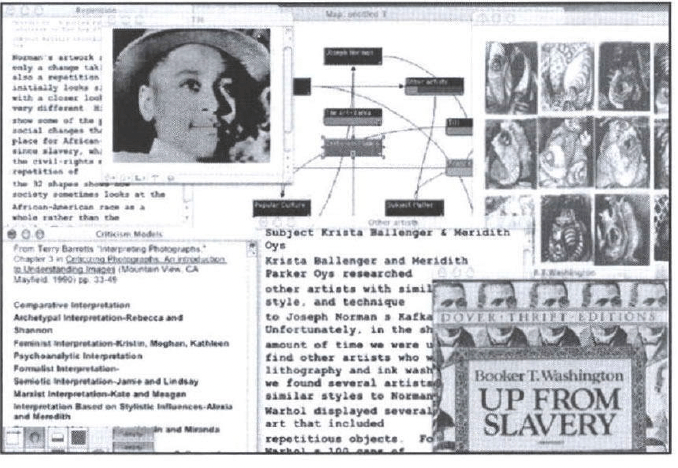
For method, Taylor and Carpenter used two forms of specially designed hypertext software to have students create collagelike visual hypertexts—visual “quilts” of information from which their subjects crafted visual representations of the connectedness of themes and ideas in a minds-on approach that mimics Danto’s goals of art criticism. Through two hypertext software applications—Storyspace and Tinderbox—they had students create hypertext documents to support research on an assigned art piece. The hypertexts became “manageable spaces where students can see and compare their notes, synopses, and ideas simultaneously.” They wrote, “The very messy, complex nature of hypertext may in fact be the key to its use as a successful educational approach in art education.” (p. 41) and that “computer hypertext may serve as a model for the kinds of divergent and inventive thinking integral to the study and making of art. Interactive computer hypertext is one way of seeing while exploring, of witnessing while performing, of correcting while blundering, and uncovering”—all practices critical to the creative, meaning-making experience. The research paper does not make clear how many students were involved in the “study” or whether a formal study was launched at all, nor does it make clear the time period during which their observations occurred. However, their paper does provide a useful set of informal observations and reflections on the use of the stated software in the authors’ own classrooms.

Taylor and Carpenter describe art criticism and by implication learning from art as a minds-on process by which the viewer looks actively and critically at what they see to uncover meaning. They point to hypertext learning as an excellent facilitator for this kind of learning, because it allows the learner to construct personal meaning from an ill-structured set of content, and thus create new perspectives. This echoes what has been suggested in other readings (Shapiro and Niederhauser, 2004) in that students who learn in a hypertext environment versus a traditional, linearly-organized format do not show a noticeable difference in their ability to identify and retain ideas and facts, but they do prevail when it comes to being able to connect, synthesize, and apply those ideas and facts in novel ways. They support Jonassen, Howland, Moore, and Marra’s (1999) argument that an ideal use for hypermedia (aka hypertext) as “primarily an environment to construct personal knowledge and learn with, not a form of instruction to learn from.” They describe this as a “liberatory” learning process that more closely imitates the inter-connective and naturally disorganized way that the mind works naturally, and thus it is ideally suited for artistic learning.

Additional Sources Cited:

Danto, A. (1992). Beyond the Brillo Box. New York: Noonday Press.

Jonassen, D. H., Howland, J., Moore, J. and Marra, R.M. (1999) Learning to solve problems with technology: A constructivist perspective (2nd ed.) Upper Saddle River, NJ: Merrill Prentice Hall.

Shapiro, A., & Niederhauser, D. (2004). Learning from hypertext: Research issues and findings. In D. H. Jonassen (Ed), Handbook of Research for Educational Communications and Technology (pp. 605-620). New York: Macmillan.

Wiggins, G. add McTighe, J. (1998). Understanding by Design.  Alexandria, VA: Association for Supervision and Curriculum Development.

“The Web as an Information The Web as an Information Resource in K–12 Education: Strategies for Supporting Students in Searching and Processing Information.”

ANNOTATION: Kuiper, Els, Monique Volman, and Jan Terwel. “The Web as an Information Resource in K–12 Education: Strategies for Supporting Students in Searching and Processing Information.” Vrije Universiteit Amsterdam. Review of Educational Research. Fall 2005, Vol. 75, No. 3, pp. 285–328.

This article from 2005 is a meta-analysis of research in Web-based learning from 1997-2002. The authors reviewed studies evaluating the Web from many angles as a teaching resource in K-12 education. The authors present a complex array of conclusions and observations, but chief among them is the recognition that the Web is a nearly bottomless source of information and that the best uses for it in education are not for information finding, but rather for information synthesis, aka “inquiry activities.” In evaluating a wide array of existing literature as of 2005, they conclude that what is needed most in Web education for children is training information literacy: teaching children how to find information, how to evaluate it, and how to process and apply it. Future research, they suggest, should focus on how the use of the Web can contribute not to information transfer but rather to “deep and meaningful” learning activities.

The authors limited their search to the SSCI and ERIC databases and focused on empirical studies from a relatively short period at the dawn of widespread Internet use, yet it is interesting to note how many of the suggestions presented in this article have been implemented in schools and are still nearly universally applicable. For example, in my own district, what was formerly library science curriculum has become information literacy, or “LITS”—teaching children how to search for, evaluate, verify, and apply the vast amount of information at their fingertips. The language used in this article echoes the vocabulary of 21st-century learning, in that the emphasis of school-based learning must evolve from information dissemination and intake into critical thinking and creative problem solving. Methodologically, the authors posed the question of how children approach Web research from four perspectives: searching strategies and search results, the effect of student characteristics on use of the Web, the effect of task characteristics (such as whether queries are self-generated or assigned), and interface characteristics (students like more pictures and avoid plain, text-heavy pages). They conclude that most researchers on children’s use of the Web agree on two items: 1) children must acquire search skills as well as skills to use the information they find, and 2) children need to be taught to discriminate and be able to recognize the relative authority and reliability of information that they find. In the end, the authors did find an answer to their central question, which is, to paraphrase, “Is Web learning different than book learning, and if so, how do we teach students to use it accordingly?” The answer is yes, it is different, and we need to train students in information literacy and provide supervision and support to ensure that they are getting the most from it.

Applying this to the work I do and my own research interests: In designing effective online arts instruction with subject matter experts, the implications are this: There is no lack of information and instruction on the Internet, but it can be challenging for new learners of any age to discriminate between what is sound instruction and what is not. The role of our online courses is much like the role of the teacher in the classroom in supporting a young learner seeking to learn via the Web: Course content together with live, online instruction can help students curate, condense, synthesize, and apply the vast amount of information available on the Web to their own creative endeavors.  Online arts courses like these should not focus so much on information transfer, but rather should provide students guidance on how to process that information to help develop their individual artistic skills. Just as Web learning needs to be about teaching students how to connect and process the information they find, online arts learning needs to be designed not to simply transfer skills but to use that information for individual expression and creativity. As k-12 school teachers serve as a guide in Web-based learning, so can online arts teachers provide personalized feedback, creative direction, and emotional support, offering student-specific input and guidance to help students learn how to apply and reshape what is known about their creative domain in service of each student’s unique passion and purpose.

“Bringing a ‘What’s the problem represented to be?’ approach to music education: A National Plan for Music Education 2022”

ANNOTATION: Carol Bacchi (2023) Bringing a ‘What’s the problem represented to be?’ approach to music education: a national plan for music education 2022, Music Education Research, 25:3, 231-241, DOI: 10.1080/14613808.2023.2223220

This article presents Carol Bacchi’s “What’s the Problem Represented to Be?” (WPR) critical approach to interpreting the UK’s National Plan for Music Education document (2022). First presented in 1999, WPR was conceived as a means by which to interrogate political policy. Its intention was to read into any given policy proposal to infer what societal problem it is intending to solve, and then interrogate the assumptions that lead to interpreting any given societal condition as a “problem.” In this article, Bacchi applies WPR’s seven-question approach to analyze the underlying assumptions, questions, and messages apparent and implied in the proposals presented in the National Plan for Music Education. Rather than analyze the “shoulds” that the National Plan suggests, she presents an alternate way of thinking about the primary debates in music education: progression/development (i.e., how do we define, evaluate, and mark “progress” in music learning?), inclusion and diversity (how to we ensure equal access), talent and creativity (how can our training contribute to the national talent pool… and what is implied in that very question), teacher training and professionalism (what constitutes “training” and who is considered “worthy” as a teacher), and evidence-based policy (how do we know what works so we can fund it?). Importantly, she also suggests a number or areas for further research.

I read several articles in the process of understanding Bacchi’s WPR approach. The example Bacchi repeatedly uses i to describe the WPR framework is this: A common suggestion to increase the number of women in positions of influence is to offer training programs. This suggested solution assumes that the reason women are not in positions of influence is lack of training; training is what the problem is “represented to be.” Presenting training as a solution silences all other potential reasons and solutions for women’s absence at the table, and further, it puts the onus of fixing the problem on the women themselves, rather than questioning the ecology of conditions that may have led to this situation.

The WPR strategy is based on seven questions to be asked of any policy or any solution-directed research question:
1. What is the ‘problem’ represented to be?
2. What assumptions/presuppositions underlie this representation?
3. How has this representation come about?
4. What is left out of this question? Where are the silences? Can the problem be thought about differently?
5. What effects are produced by this particular representation of the problem?
6. How has this representation been produced, disseminated, and defended? How has it been replaced?
7. How does this list of questions apply to my own problem representations?

The questions are not intended to provide incontrovertible answers, but serve as an open-ended method of inquiry designed to continually subject existing hierarchies and hegemonies to ongoing question. Bacchi’s approach was initially conceived as a way to interrogate public policy solutions, but since has been applied widely in a variety of settings, including research and scholarship. WPR is an analytical strategy rather than a research method, but I pursued it in this assignment about research methods because it presents an alternative method to clarify and “de-subjectify” a research question. This approach applies to educational research, especially in trying to understand, characterize, and improve functions within an online learning environment in the arts, because it helps the researcher formulate and phrase the right questions before one decides on a research method that will answer those questions.

Angelique Blestas wrote of the WPR method, “… the WPR approach sidesteps, avoids, and challenges taken-for-granted approaches to ‘problem solving’ [and rejects] the idea that problems exist ‘out there’ to be stumbled upon.” She describes Bacchi’s post-structuralist approach as a challenge to the relationship between the researcher and the subject to which the research is being applied, as it questions the distinction between the phenomena and the expert. The relationship between them is more complex, and Blestas suggests that to engage in research on a subject is not to observe it passively but rather to intervene in it in some way. The approach implies that since phenomena are not fixed, there can be no final word on anything—and that perhaps providing the “final word” on something should not be the only purpose of research.

One of the more intriguing tidbits from Bacchi’s article appeared in her commentary on the National Plan’s conception of creativity. “The strong focus on the future potential of the ‘creative industries’ has been linked to the tendency for neoliberalism to economize everything. To resist this ‘colonization of creativity’ Kanellopoulos (2022, 145) endorses an alternative conceptual apparatus that might permit a conceptualization of creativity as subversive.”

Additional Resources :

“Chapter 2: Introducing the ‘What’s the Problem Represented to be?’ approach.” Bletsas, A. & Beasley, C. (eds.) 2012. Engaging with Carol Bacchi: Strategic Interventions & Exchanges. Adelaide: University of Adelaide Press.

“Chapter 4: Spaces Between: Elaborating the theoretical underpinnings of the ‘WPR’ approach and its significance for contemporary scholarship.” Bletsas, A. & Beasley, C. (eds.) 2012. Engaging with Carol Bacchi: Strategic Interventions & Exchanges. Adelaide: University of Adelaide Press.

.

Mayer’s “Thirty Years of Research in Online Learning” and Future Directions

ANNOTATION: Mayer, Richard E. Thirty years of research on online learning. Applied Cognitive Psychology. 2019; 33: 152-159.

This paper presents Richard E. Mayer’s personal overview and analysis of research developments in online learning over the past 30 years, showing the ways that online learning contributes to the science of learning (how people learn), the science of instruction (how to help people learn), and the science of assessment (how to determine whether they have learned).  Mayer is a distinguished professor of psychology at UC Santa Barbara and is widely cited and broadly recognized as a leading voice working at the intersection of cognition, instruction, and technology. Mayer’s underlying assumption in all of his work is closely tied to Clark’s famous assertion that learning is caused by instructional method not instructional media. He contends that advances in instructional technology have outpaced advances in the instructional sciences needed to determine how best to use them. In this short paper, he provides a broad overview of the evolution of research in online learning and learning psychology over the last thirty years and concludes that ongoing research in learning science should focus on three things: 1) identifying and maximizing the benefits exclusive to online media, 2) finding better objective instruments to measure the cognitive processes in effect while learners are using the media, rather than relying on the learners to give accurate assessments of their own cognitive processes, and 3) identifying the conditions under which online learning methods are most effective.

I found this to be an excellent article in that Mayer clearly laid out how prevalent teaching methods since the turn of the century reflected the learning media and determined the kinds of assessment used to measure learning. When behaviorism was prevalent in the early decades of the 20th century, learning was motivated by reward and punishment, leading to drill and practice methods. Cognitivism was the prevailing theory in the 1940s-1960s, and during that time optimal learning consisted of information acquisition—leading to lectures to convey information and assessments to determine a student’s degree of fact acquisition via memorization. By the 1970s and 1980s, constructivism came along, redefining learning as the ways that learners synthesize new information against what they already know.  The latter led to learners being asked to problem-solve within real-life authentic settings.

One of the newer prevalent theories overlays constructivism—a generative model in which the student learns with understanding not just by filing the new information in relation to the old, but also by actively constructing meaning in the process. The second newer model that has arisen from online learning is cognitive load theory, which insists that instruction must be highly streamlined, and instructional designers/educators must “reduce extraneous cognitive load caused by inappropriate instructional procedures.” Cognitive load theory led to a variety of “best practices” that still guide instructional design—segmenting (chunking), pretraining (defining terms first), and modality (the ideal ways to use text in combination with audiovisual material). Mayer outlines how he has worked from both of these theories in his research on multimedia learning, and suggests that the most promising areas for further research in online learning include: affect, motivation, the effect of emotional design, the power of self-efficacy, and the way that students’ metacognition of their learning can affect how well they learn.

In terms of the science of instruction, one of the more interesting and applicable discoveries of his and others’ recent research is that students can in fact actively learn while using passive media, and that cognitive activity is not dependent on behavioral activity. In other words, yes, you can learn by doing, but you can also learn by reading, watching, and other seemingly passive activities. In my own work and research, it will be helpful to look more closely at Mayer’s enormous body of research and apply his discoveries about how people learn best with passive media to the work we do in designing instruction at an online arts institution. This can work hand in hand with research to identify sources of artistic motivation in online instruction and use this to build research-proven solutions for teaching the arts online.

“A Paradigm Analysis of Arts-Based Research and Implications for Education”

ANNOTATION: Rolling, Jr., James Haywood. A Paradigm Analysis of Arts-Based Research and Implications for Education. Studies in Art Education: A Journal of Issues and Research 2010, 51(2), 102-114.

In “A Paradigm Analysis of Arts-Based Research and Implications for Education,” author James Haywood Rolling, Jr. of Syracuse University, attempts to describe arts-based research and outline its potential for generating new curriculum approaches for general arts education practice and the development of the learner. He describes arts-based theoretical models as characteristically “poststructural, prestructural, performative, pluralistic, proliferative and postparadigmatic,” and thus prescriptive of a variety of new and useful models for art education.

New research paradigms emerge, he asserts, when old ones are not fully adequate to solve problems within a field of study. The arts-based research approach emerged accordingly, which he asserts “destabilizes the footings of the sacred monuments we make of our scientific and social scientific research methods and outcomes” in favor of a model that is more appropriate to formulating understanding in the arts, whose processes are by nature emergent, ephemeral, multiplicitous, infinitely subjective, and creative. The latter element, creativity, is critical to his conclusion that arts-based research may serve as an ideal model for future educational practices in fields beyond the arts, in which teachers face the imperative to teach creative thinking. Arts learning creates an applicable model for learning in many subjects, he asserts, in that the arts are intended to eternally achieve novel results, not the testable, predictable, and generalizable results that are hallmarks of what is widely upheld as “valid” research.

Most arts education research of the last 100 years has been focused on two things: 1) justifying the lasting value of arts education to the learner (and thus continually advocating for its place in public education), and 2) determining what curriculum and approach is best for learners. One major problem in researching artistic processes is that there is no single cause that creates an effect, nor is there a single effect that will result from the same set of “causes.”  As such, in trying to understand arts learning, a new method of research was called for to best understand the multiplicity of causes and outcomes—and indeed, to intentionally reach for results that moved beyond simply understanding cause and effect, but rather pointed toward unseen directions. This is arts-based research.

Once you decode the patois of pedagogical parlance too perplexing for the pared-down position of this annotation paradigm (perorations if presented in propria persona might possibly prescribe a a plastic poncho), the article presents rich thinking worthy of a fuller exploration for my own research in learning technology in the arts, particularly because it points to the multiplicity of effective approaches to intentionally achieving unpredictable results—that is, in using creative methods to understand and characterize the multiplicity of processes that achieve creative ends. In short, a method that prioritizes discovery over description, peculiarity over predictability.

“Making Artistic Learning Visible: Theory Building Through A/r/tographical Exploration”

ANNOTATION: Ruopp, Amy, and Kathy Unrath. “Making artistic learning visible: Theory building through a/r/tographical exploration.” Visual Arts Research, vol. 45, no. 2, 2019, pp. 29–48, https://doi.org/10.5406/visuartsrese.45.2.0029.

In this article, authors Ruopp and Unrath present the results of a six-week research project with 15 pre-service art teachers in a project aimed at developing aspiring teacher/artists’ ability to articulate how creative and artistic learning unfolds. In the research, pre-service teachers videorecord, photograph, and write reflections on themselves as they narrate their process while creating an original piece of art. They then reduce the hours of videorecordings into a concise 10-minute video in which they review, analyze, then present their creative process. The intention is to develop in preservice teachers an “(a)rtist/(r)esearcher/(t)eacher (a/r/tographic understanding of the creative process, from which they develop their own theory of artistic creation to use in teaching their future students. The authors conclude that their work inspired deep, self-directed and non-linear learning about process, and led individual teachers to develop personal and unique theories about how the artistic process unfolds through embodied reflection process—that is, by doing, noticing, thinking, and reflecting. They reported that their research indicated that they had effectively engaged the “teacher” self and the “artist” self in decoding a process that is typically nonlinear—the authors refer to it as “rhizomatic,” in that creative concepts are generated from interconnected ideas and exploration across many fronts from many starting points. Finally, they conclude that their approach would be an effective way to improve the teaching to build 21st century skills and thinking processes.

The project was well-designed in that Ruopp and Unrath found ways to have artists create in a self-reflective way. The ten-minute video that required a/r/tographers (future teachers) to “revisit, review and research their process over and over again” seemed to be highly effective, according to the teachers’ self-reflection papers. In their later self-reflection, the preservice teachers shared revelations and discoveries about that process and considered how they might incorporate what they have learned into their own teaching. The authors employed a clear overview of what read as a sound research process, and they presented comprehensive analysis of their creative and nonlinear approach to processing the data. It would be helpful to see this research repeated with similar subjects but with a much larger sample size over a period of time, and to read follow-up research on how and whether these preservice teachers later applied what they learned to their approaches in the classroom. The project was very effective in modeling process through embodiment (learning by doing) and encouraging self-learning to the preservice teachers. These are the very same skills and approaches that teachers are encouraged to develop in their own students according to 21st century new arts standards that emphasize reflection and creation.

It was encouraging to read about the authors’ philosophy that creativity is a critical part of art instruction, and it is easy to see how explicit instruction in the creative process itself has been overlooked over time—because it is problematic at worst and challenging at best. Creativity is nonlinear and rhizomatic, drawing from many sources, many of which are not always consciously known by the artist. According to the authors, creativity requires the artist to feel comfortable moving into the unknown and to value a feeling focus rather than an intellectual focus in the process—a focus that could at times bump up against a more traditional, straightforward quantitative approach. The project idea itself was particularly exciting to me, in that I have observed from my own role as a public school music teacher that public school teachers who have been trained in traditional teaching methods struggle with the new arts standards, in which they are asked to teach “creativity” but were never explicitly taught to be creative themselves—nor were they taught to reflect upon and discover their own creative process. Further, I have witnessed that teachers do not always view themselves as active artists, nor do they engage actively and professionally in the art that they are teaching, having been taught in an instructivist approach that emphasized repetition of taught skills and a pre-established body of knowledge and technique, rather than venturing into a more open-ended creative and ultimately more innovative path. Encouraging teacher/artists to be more reflective and analytical of their own work would seem to be an effective way to train them to be able to articulate their process, and then teach it. Creativity in learning and learning with creativity is very much at the center of my research interests, and I was truly excited to read this work.