Author’s Note: This post takes a practical approach to using MagicSchool’s generative AI functions. The many ethical issues that surround the use of AI generative tools have been published broadly. The Center for Teaching Innovation at Cornell University presents an outline of some ethical concerns that can inform educators as they navigate these complexities andContinue reading “Exploring MagicSchool.ai to Help Teach Musical Styles”
Author Archives: susangedutis
The Big Question:

On Adolescent Creativity in Online Learning The final assignment for EDU800 was an “elevator pitch”—an exercise in developing the ability to clearly and succinctly communicate our current interests at any given time. Wow. It was hard—not the writing of it; the delivering of it. We were asked to create and post a two-minute video outliningContinue reading “The Big Question:”
The Adolescent Community of Engagement: A Framework for Research on Adolescent Online Learning

Image: Joy Reeves – The Center for Transformative Teaching and Learning at St. Andrew’s Episcopal School. ANNOTATION: Borup, J., West R., Graham C. and Davies, R. (2014) The Adolescent Community of Engagement: A Framework for Research on Adolescent Online Learning. Journal of Technology and Teacher Engagement 22(1), 107-129. Enrollments in K-12 online learning continue toContinue reading “The Adolescent Community of Engagement: A Framework for Research on Adolescent Online Learning”
Higher Order Thinking in an Online World: Toward a Theory of Web-Mediated Knowledge Synthesis

ANNOTATION: Higher Order Thinking in an Online World: Toward a Theory of Web-Mediated Knowledge Synthesis Deschryver, M. (2014). Higher order thinking in an online world: Toward a theory of web-mediated knowledge synthesis. Teachers College Record, 116(12), 1-44. Access to the web is nearly ubiquitous at home, work, and school. Most people use the web for straightforward information-based tasks, butContinue reading “Higher Order Thinking in an Online World: Toward a Theory of Web-Mediated Knowledge Synthesis”
Creating technology-enhanced, learner-centered classrooms: K–12 teachers’ beliefs, perceptions, barriers, and support needs

PHOTO: iStock ANNOTATION: An, Y. J., & Reigeluth, C. (2011). Creating technology-enhanced, learner-centered classrooms: K–12 teachers’ beliefs, perceptions, barriers, and support needs. Journal of Digital Learning in Teacher Education, 28(2), 54-62. Twenty-first century educational thinking moves beyond what Reigeluth (cited in paper, 1994, 1999b) referred to a factory-model “sorting” role, to achieve a higher-order learning role better designedContinue reading ” Creating technology-enhanced, learner-centered classrooms: K–12 teachers’ beliefs, perceptions, barriers, and support needs”
On the Nature of Creativity: Drawing from the PISA 2021 Creative Thinking Framework
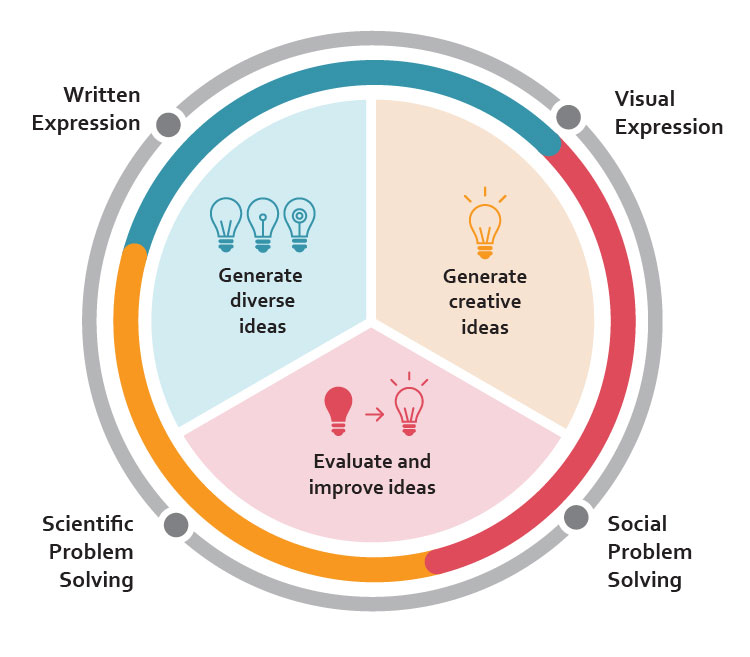
CITATION: OECD. (2019). Framework for the Assessment of Creative Thinking in PISA 2021 (Third Draft) This is a long entry—much longer than I normally post—that in effect summarizes the PISA Creativity Framework, the theoretical foundation for an international test designed to assess creativity. This post begins with an overview of the assessment, then moves into a descriptionContinue reading “On the Nature of Creativity: Drawing from the PISA 2021 Creative Thinking Framework”
Autonomy support, personality, and mindset in predicting academic performance among early adolescents: The mediating role of self-determined motivation.

CITATION: Mammadov, S., & Tozoglu, D. (2023). Autonomy support, personality, and mindset in predicting academic performance among early adolescents: The mediating role of self-determined motivation. Psychology in the Schools, 60, 3754–3769. https://doi.org/10.1002/pits.22966 This paper supports a tenet that is highly unsurprising: Young adolescents—that is, middle school students—who are very conscientious and who have high levels of autonomy support from teachers and parentsContinue reading “Autonomy support, personality, and mindset in predicting academic performance among early adolescents: The mediating role of self-determined motivation.”
Profiles of personal and ecological assets: Adolescents’ motivation and engagement in self-driven learning

Zhu, G. and Burrow, A. (2021). Profiles of personal and ecological assets: Adolescents’ motivation and engagement in self-driven learning. Current Psychology 42:14025-14037. https://doi.org/10.1007/s12144-021-02412-0 Opportunities for self-driven, informal learning for teens are on the rise, but little is known about what motivates students to seek these activities, nor about what keeps them engaged when they findContinue reading “Profiles of personal and ecological assets: Adolescents’ motivation and engagement in self-driven learning”
Fledgling Thoughts on AI from Four Assigned Readings

Photo Credit: Tierney – stock.adobe.com The following shares some thoughts on AI in education, based on four scholarly papers on the subject. The content below includes two big ideas that stood out per article, followed by one(ish) sentence on how it changed what I think of AI or how it might apply to my work. TruthContinue reading “Fledgling Thoughts on AI from Four Assigned Readings”
On the Development and Practice of AI Technology for Contemporary Popular Music Production

[Photo: Berklee Online.] ANNOTATION: Deruty, E., Grachten, M., Lattner, S., Nistal, J., and Aouameur, C. (2022). On the Development and Practice of AI Technology for Contemporary Popular Music Production. Transactions of the International Society for Music Information Retrieval, 5(1), 35–49. DOI: https://doi. org/10.5334/tismir.100 The music industry has been abuzz with discussion on AI’s entry intoContinue reading “On the Development and Practice of AI Technology for Contemporary Popular Music Production”
 Susan Gedutis Lindsay